• Home
  • Services
  • About
    • Philippi Advantage
    • Mission
  • Projects
  • Job Openings
  • Blog
  • Contact
  • desk
  • Aurora-MCTR
  • medical-center
  • Investors-Bank
  • Aurora-BCMC
  • Aurora-MOB-TR
  • blueprint

Archive for Construction – Page 3

Posted by Boyd Philippi on
 January 20, 2012

The Many Benefits of Building Green

According to the Environmental Protection Agency, buildings in the United States account for 39 percent of total energy use, 12 percent of total water consumption, 68 percent of total electricity consumption, and 38 percent of carbon dioxide emissions! By building green, we can reduce the impact on the natural environment, economy and even human health.  Green construction methods can be integrated into buildings at any stage, from design and construction, to renovation and deconstruction.

Environmental benefits: 

1.  Enhance and protect biodiversity and ecosystems

2.  Improve air and water quality

3.  Reduce waste streams

4.  Conserve and restore natural resources

Economic benefits

1.  Reduce operating costs

2.  Create, expand, and shape markets for green product and services

3.  Improve occupant productivity

4.  Optimize life-cycle economic performance

Social benefits

1.  Enhance occupant comfort and health

2.  Heighten aesthetic qualities

3.  Minimize strain on local infrastructure

4.  Improve overall quality of life

Add green building expertise to all your business offerings and give homeowners the assurance that their homes are healthier, and more energy and resource efficient.  As an added incentive, building green improves property values at the time of sale.  The following are examples of incorporating green in your building project:

1.  Energy efficiency:  Lighting, insulation, heating and cooling

2.  Resource conservation:  Using recycled materials and building durable

3.  Indoor air quality:  Using healthier materials and building for optimal ventilation

4.  Water conservation:  Using high efficiency toilets, dishwashers and washing machines and building drought resistant landscapes

5.  Community:  Working with neighborhood associations to assure low crime and walkable neighborhoods, bicycle friendly paths and parks

Construction companies should make their clients aware of the many benefits of building green.  You can provide added value to all your client transactions by guiding them toward healthier, economically sound decisions.


Categories : Commercial, Construction, Green, Residential
Tags : commercial building, green buidling, residential building
Posted by Boyd Philippi on
 January 12, 2012

The Philippi Quality Construction Advantage!

blueprintsExcellent results with Single Source

Dividing a construction project between architect and builder can cause problems. Why? Because the process and lines of responsibility can be ignored, increasing the possibility of costly items falling through the cracks and being missed. Philippi Quality Construction’s philosophy solves that problem by accepting full responsibility for the design and construction.

Design/Build means being the customer’s single point of contact is with the people who are dedicated to customer’s satisfaction. Philippi Quality Construction is committed to being that one source and will guarantee to keep everything on track, on time and on budget, which gives customers more time to plan for opportunities and possibilities.

Commitment to Satisfaction

With any construction company, the benchmark of success has to be its level of customer satisfaction. Philippi Quality Construction strives to keep their customers engaged with the workflow throughout the project. All clients are updated on the building’s progress, fully explaining each step, answering all questions, offering clear, understandable options and making sure your project stays on time and on budget. 

Guarantee

Every Philippi Quality Construction project comes with a 1-year guarantee of materials and craftsmanship for a specified period of time following the completion of the project. Philippi Quality Construction believes in standing behind the final product and that means working with the customer to resolve any issues to everyone’s satisfaction.

Philippi Quality Construction is located in Manitowoc, Wisconsin and has more than twenty years experience as designers and builders in markets including healthcare, commercial, industrial, institutional and recreational facilities.

For more information on the Philippi Construction Advantage, go to www.manitowocconstruction.com.

Categories : Commercial, Construction, Health Care Facilities, Residential
Tags : commercial construction, construction, residential construction
Posted by Boyd Philippi on
 January 6, 2012

6 Recommendation for Commercial Concrete Driveway Installation

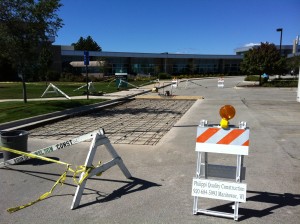
0028Specifications for commercial concrete driveways are stricter than residential concrete driveways. This is because large, heavy trucks and other vehicles regularly use them. Heavier vehicles require thicker concrete and base depths to avoid cracking and deterioration of the concrete. Each city or township has its own requirements for commercial driveway specifications.
Here are 6 recommendations to keep in mind when installing commercial concrete driveways:

  1. The base for a commercial concrete driveway should be a minimum of 6 inches thick, made up of an aggregate base material and fully compacted. Excavation for the driveway, therefore, needs to be the depth of the concrete plus 6 inches more, to accommodate for the base.
  2. A reinforcement layer of wire mesh or rebar above the base layer (1 inch from the bottom of the slab) is necessary to keep cracks from starting and expanding.
  3. Commercial concrete driveways should be at least 6 inches deep.  Some local codes will require 8 inches.  Check with your local zoning and codes.
  4. If using fiber-reinforced concrete, the same depth of your pour is required.
  5. Expansion joints are necessary when concrete slabs touch fixed objects like foundations, street curbs, etc.
  6. Keep your eye on weather!  Ideal conditions are 55 degrees, overcast and high humidity.  Don’t pour concrete in extreme hot or cold weather.
Be sure to check out all the construction services offered by Philippi Quality Construction at the company website at www.manitowocconstruction.com!


Categories : Construction
Tags : commercial concrete, driveway construction
Posted by Boyd Philippi on
 December 28, 2011

Health Care Facilities – Considerations to Design and Construction

Before a construction company can begin the process of design, construction or renovation of any health care facilities, it is necessary to gather data regarding architectural, mechanical, electrical, plumbing and fire protection requirements established by OSHA and other federal, state and local agencies. Collection of this data is critical because it can affect issuance of a certificate of occupancy and site considerations; planning and zoning requirements; fire safety ordinances; state and local codes; natural gas supplies; domestic and fire water requirements; electrical power; and sanitary sewer facilities.

Use a checklist to prevent the possibility of overlooking essential zoning and code requirements, which could delay the construction or renovation project.  Be sure the checklist assigns key individuals who serve as technical sources throughout the project, such as the fire marshal, inspectors (city/state/local), zoning authorities, utility company officials, health care facility officials, etc.  These key assigned individuals will establish clear lines of communication with the authority having jurisdiction and can prevent misunderstandings and delays on the project with the design/construction company.

When seeking approval for new construction or renovation of existing health care facilities, it is recommended that your proposal and design plan consider the following important factors:

1.  The scope and purpose of the proposed construction project;

2.  The services necessary for the complete operation of the health facility, including:

  • The size and function of each space,
  • Any special design features,
  • The projected occupant load, and
  • Numbers and types of staff, patients, residents, visitors and vendors;

3. The types and projected numbers of procedures to be performed in each treatment area and circulation patterns for staff, patients or residents, and the public;

4. The projected demand or utilization, staffing patterns, departmental relationships, space requirements, and circulation patterns that are a function of infection control requirements and for clean and soiled materials;

5. Equipment requirements, including building service equipment and fixed and moveable equipment; and

6. Potential future expansion that may be needed to accommodate increased demand.

Use of dust-control procedures and barriers during construction, repair, renovation, or demolition is essential to protect other parts of health care facilities. Whenever possible, avoid inactivating or shutting down the entire HVAC system, especially in acute-care facilities. If feasible, design and install fixed backup ventilation systems for new or renovated construction of operating rooms, laboratories other critical-care areas.

During the construction or renovation, establish a multidisciplinary team that includes infection-control staff to coordinate demolition, construction, and renovation projects and consider proactive preventive measures at the inception. This team should educate both the construction team and health-care staff in immune compromised patient-care areas regarding the airborne infection risks associated with construction projects, dispersal of fungal spores during such activities, and methods to control the dissemination of fungal spores. Incorporate mandatory adherence agreements for infection control into construction contracts, with penalties for noncompliance and mechanisms to ensure timely correction of problems. This team should also establish and maintain surveillance for airborne environmental disease as appropriate during construction, renovation, repair, and demolition activities to ensure the health and safety of immune compromised patients.

The construction company should implement dust-control measures on surfaces and divert pedestrian traffic away from work zones. Relocate patients whose rooms are adjacent to work zones, depending on their immune status, the scope of the project, the potential for generation of dust or water aerosols. Provide construction crews with designated entrances, corridors, and elevators wherever practical; essential services (e.g., toilet facilities) and convenience services (e.g., vending machines); protective clothing (e.g., coveralls, footgear, and headgear) for travel to patient-care areas; and a space or anteroom for changing clothing and storing equipment.

The above guidelines are just a sample of things to consider when approaching  renovation, construction or demolition of health care facilities. Be sure to research all applicable OSHA codes and local and state regulations regarding full requirements for health care facility construction, renovation or demolition.


Categories : Construction, Health Care Facilities
Tags : health care construction, OSHA
Posted by Boyd Philippi on
 December 19, 2011

8 Tips for Hiring A Professional Carpenter

0222Updating your kitchen cabinets?  Building custom furniture or a new closet?  You will need to find an experienced and skilled carpenter to do the job right at a price that matches your budget!

1.  Ask an expert for a recommendation.  Get a recommendation from a general contractor as they know who is reliable and does quality work.  You can also ask your friends and neighbors to recommend a carpenter who has done similar work to the specific job you are seeking.

2.  There is no substitute for experience.  Carpenters learn their trade on the job and through apprenticeships, which usually take about 4 years to complete.  Call the carpenter’s references and make sure that he is reliable and punctual.  A good carpenter should have 3 to 5 years experience minimum.

3.   Look for signs of a skilled, professional carpenter.  A good carpenter should have a high degree of visual skill and attention to details in order to complete a quality project.  He should be dressed appropriately and be self-motivated.

4.   Get photos of recently completed projects.  You should be able to see the carpenter’s past projects to assess his abilities and workmanship.  If possible, ask if you can visit a current project site to inspect his work.

5.   Layout project details and information.  Have your plans ready to share with the potential carpenter to assess if he is willing and able to do the job in the time frame you need it completed.  Know what you want to get a clear contract price and to be sure you like what you get!

6.   Get it in writing!  You want to make sure both parties know what is included in the price and what is expected.

7.   Be sure to include dates of completion in contract.  The carpenter will need to have a reasonable time frame set to complete the project.  Add a clause which charges penalties for not completing the work by deadline date.

8.   Keep your eyes open.  Find a carpenter that you can communicate with and check in to make sure he is on task and following your instructions.

Categories : Construction
Tags : carpenter, commercial building, residential building
« Previous Page
Next Page »

Recent Posts

  • Four Tips to Schedule and Manage Construction Projects With Ease!
  • Routine Maintenance Will Extend Your Roof’s Life and Save You Money!
  • Enjoy Spring in Wisconsin On Your New and Updated Deck
Philippi Quality Construction ~ 4223 Expo Drive ~ Manitowoc, WI 54220
920.684.5993
Copyright © 2026 All Rights Reserved

website design and hosting
by Nerd Free Marketing
MENU
  • Home
  • Services
  • About
    • Philippi Advantage
    • Mission
  • Projects
  • Job Openings
  • Blog
  • Contact